Loading

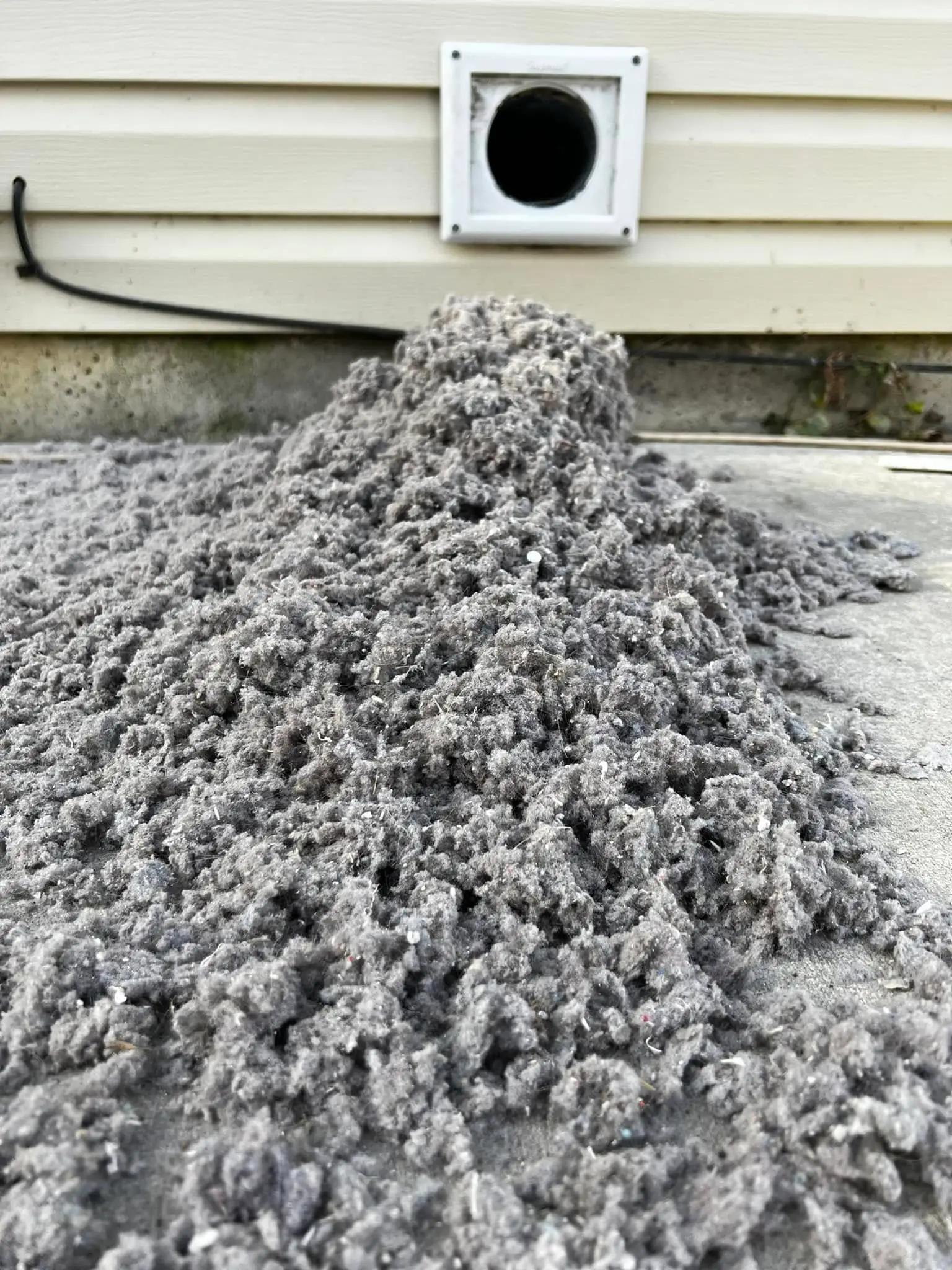
Every load of laundry sheds lint, and the lint trap only catches part of it. The rest travels into the duct and settles at every elbow, seam, and low spot in the run. Dayton's housing stock makes this worse than average: century-old homes in Oakwood and St. Anne's Hill often vent through long basement runs, while newer builds in Springboro and Beavercreek push the dryer to an interior wall or second floor with multiple elbows. Both designs trap lint fast.
We clean from both ends. A rotary brush on a flexible rod scrubs the full length of the duct while a negative-air vacuum captures everything it releases, so nothing blows back into your laundry room. We pull the dryer, clean the lint trap housing and the back panel, clear the exterior hood and damper, then measure airflow at the termination before and after so you have a number — not a promise — proving the restriction is gone.
You get before-and-after photos the same day, the floor vacuumed, and the dryer reconnected and tested. Most Dayton homes need this once a year; larger households, pet owners, and long duct runs do better every six to nine months.
not sure? just ask.
Describe your setup on the phone and we'll tell you honestly which service you need — even when the answer is none of them.
Lint builds the same way in a single-family laundry room and in a 40-unit building's shared exhaust — it just builds faster where the machines never stop. We run both sides of the work across the Miami Valley.
Houses, condos, and townhomes in Dayton, Oakwood, Kettering, Beavercreek, Centerville, and Springboro — cleaned on an annual cycle with airflow tested before and after.
Apartment buildings, senior living, salons, gyms, restaurants, and coin laundries — scheduled service with per-unit reports, after-hours windows, and documentation for ownership.
The transition and wall connection collect the heaviest buildup, and it's the part nobody pulls the dryer out to check. We clean it every visit.
Packed wall-to-wall with lint on the left, bare metal on the right. This is what a measured airflow improvement actually looks like inside the run.
We quote a flat price per home instead of an hourly rate, so you know the number before we start. Three things move it:
A short exterior-wall vent cleans faster than a 30-foot basement run with four elbows.
Ground-level hoods are simple; roof terminations need a ladder and extra time.
A duct that's fully packed or partly disconnected may need repair, quoted before we proceed.
Anything not covered here, ask on the phone — we'd rather answer it than have you guess.